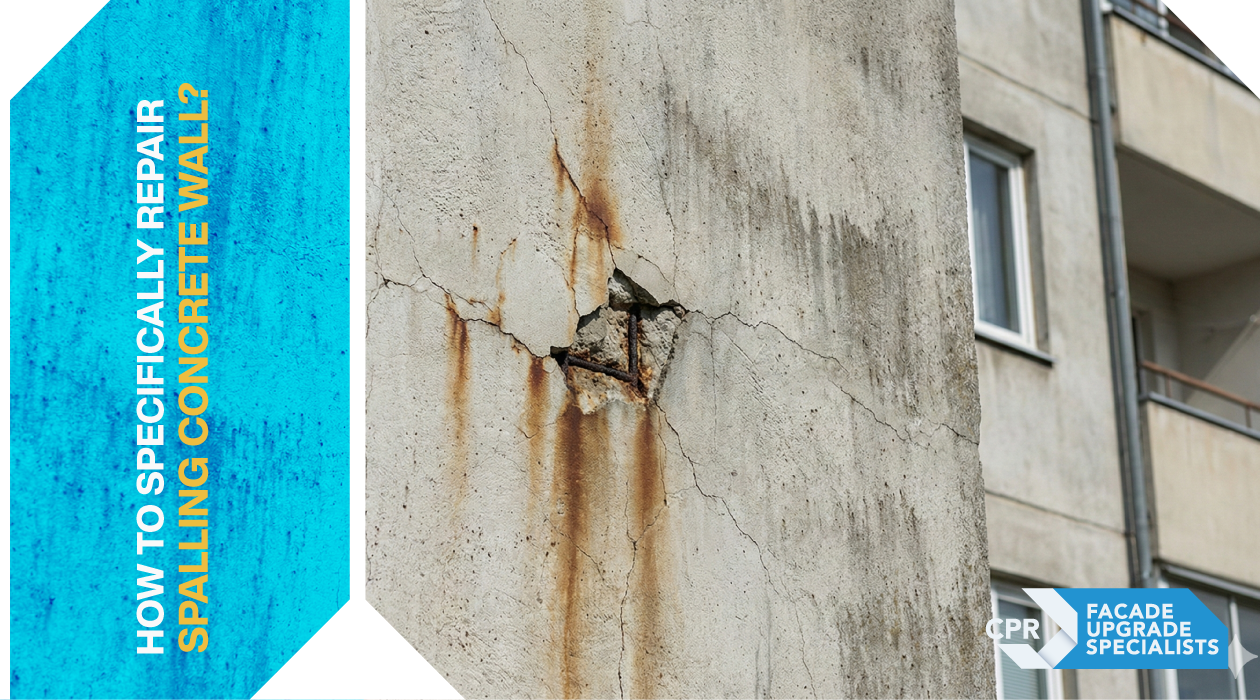
How to specifically repair spalling concrete wall? It is one of the most common questions strata committees, building managers, and consultants face when concrete deterioration first appears on building facades. It is also one of the most misunderstood.
If you are seeing cracked concrete, rust stains, exposed steel, or pieces of concrete breaking away, it is completely normal to feel worried. Concerns about safety, escalating costs, resident complaints, and whether this will turn into a never‑ending repair cycle are very real.
This guide explains how to specifically repair spalling concrete walls in an Australian context — clearly, honestly, and without technical smoke and mirrors. It also explains why a data‑driven, Scaffold‑Free™ approach supported by AIMMS™ is now the safest and most cost‑effective long‑term solution for high‑rise and difficult‑access buildings.
What Is Spalling Concrete and Why It Happens on Facade Walls
For strata committees, recognising these early signs is not just about understanding the problem — it is about knowing when responsibility shifts from observation to informed decision-making to protect safety, budgets, and long-term asset value.
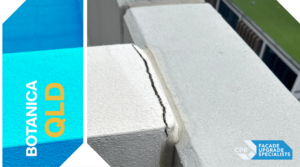
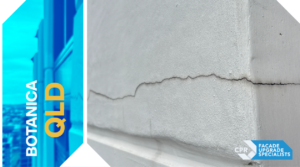
Spalling occurs when concrete breaks away from the surface, usually exposing reinforcing steel underneath. On facade walls, this is not just a cosmetic issue — it is often an early warning sign of concrete cancer.
Common causes include:
- Moisture penetration through cracks or failed coatings
- Carbonation reducing concrete alkalinity
- Corrosion of steel reinforcement
- Poor original construction or insufficient cover to rebar
- Long‑term exposure to coastal or urban pollution
Once corrosion starts, steel expands, forcing the surrounding concrete to crack and detach. Left untreated, this accelerates rapidly.
Why Ignoring Spalling Concrete Walls Is a Risky (and Expensive) Decision
For strata committees, the fear is understandable: “If we start repairing this, will costs blow out?”
For building managers and consultants, the concern is different: “Will this escalate into a safety or compliance issue?”
Ignoring spalling concrete can lead to:
- Falling concrete hazards
- Escalating repair scopes
- Structural concrete repair becoming unavoidable
- Higher insurance and compliance risk
- Repeated short‑term patch repairs that fail prematurely
Early, properly specified spalling concrete wall repair in Australia consistently costs less than reactive emergency works.
How to Specifically Repair Spalling Concrete Walls – The Correct Methodology
This section outlines the proven, step‑by‑step process required to repair spalling concrete walls correctly, safely, and in a way that delivers long‑term durability rather than short‑term patch fixes.
Repairing spalling concrete walls is not about filling cracks and repainting. It is a precise, staged process.
Step 1: Accurate Diagnosis Using AIMMS™
Before any repair begins, the facade must be inspected and quantified.
CPR uses AIMMS™, our proprietary inspection and asset intelligence system, which maps every defect, crack, and spalled area.
Which means for you…
- No guesswork
- A fixed, transparent scope of works
- Clear prioritisation instead of blanket repairs
This step alone prevents unnecessary over‑repair and cost escalation.
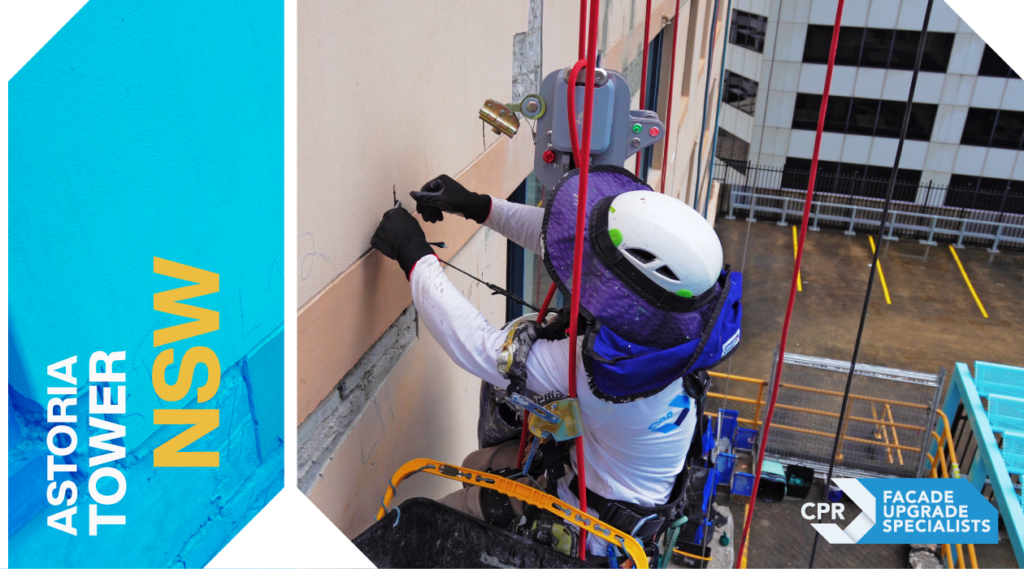
Step 2: Safe Removal of Unsound Concrete
All loose, delaminated, and contaminated concrete is carefully removed back to sound substrate.
This is critical. Leaving compromised material behind is the main reason many concrete patch repairs fail.
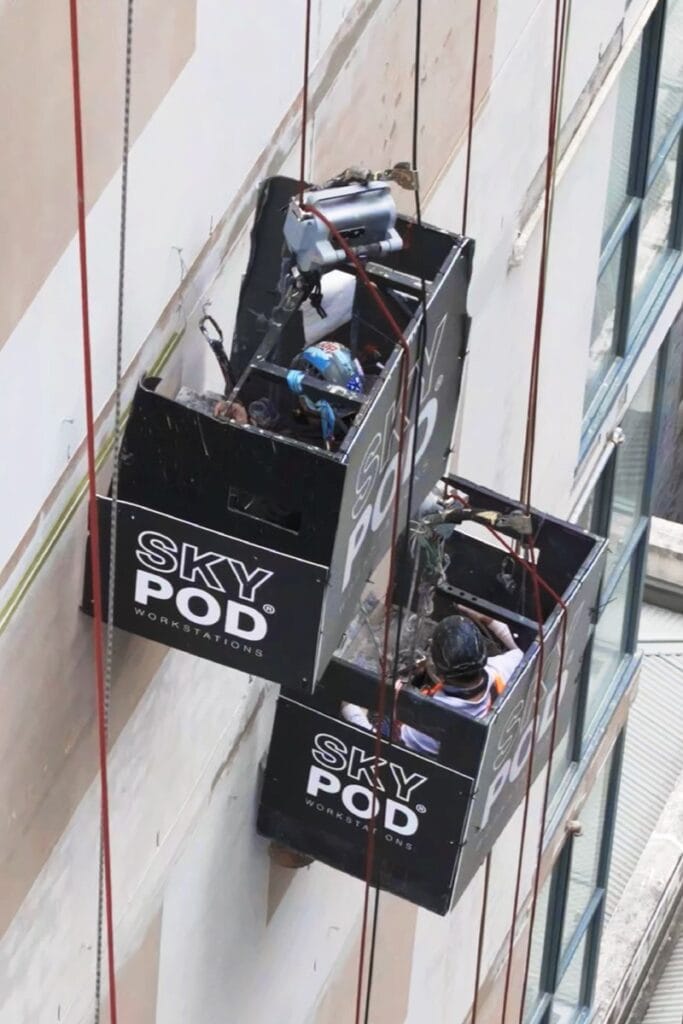
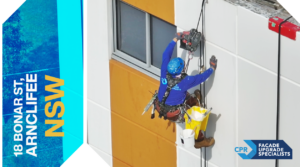
Using Scaffold‑Free™ access systems such as SkyPod®, CPR performs this work externally, without entering apartments.
Which means for you…
- Minimal disruption to residents
- Faster mobilisation
- Reduced access costs
Step 3: Treating and Repairing Exposed Reinforcement
When steel is exposed, it must be properly treated.
This includes:
- Mechanical cleaning of reinforcement
- Corrosion inhibition
- Replacement or augmentation where required
This stage is essential for repairing concrete wall exposed rebar correctly.
Which means for you…
- Slowed or halted corrosion
- Structural integrity preserved
- Multi‑decade durability, not short‑term fixes
Step 4: Rebuilding the Concrete Profile
This stage is where professional expertise makes the biggest difference between a long-term solution and a repair that fails prematurely.
High‑performance repair mortars are applied to rebuild the concrete profile.
The selection of materials depends on:
- Exposure conditions
- Structural requirements
- Compatibility with existing concrete
This is where many DIY concrete spalling repair attempts fail — incorrect products or application methods dramatically shorten lifespan.
Which means for you…
- Repairs that last 10–20+ years
- Reduced future maintenance cycles
Step 5: Protective Coatings and Durability Treatments
Once repairs are complete, the wall is protected using breathable, engineered coatings.
These systems reduce moisture ingress while allowing vapour transmission.
This step transforms a repair into a concrete wall restoration Australia‑ready solution, not just a patch.
Why DIY Concrete Spalling Repair Is Rarely Suitable for Facades
While DIY concrete spalling repair may be suitable for small, non‑structural ground‑level elements, it is not appropriate for facade walls.
Reasons include:
- Working at height risks
- Inability to assess internal corrosion
- Lack of compatible materials
- No long‑term warranties
For strata and commercial buildings, professional remedial concrete repair services Australia are essential.
Scaffold‑Free™ Concrete Repairs: Why Access Method Matters
Traditional scaffolding often represents up to 30% of total project cost.
CPR’s Scaffold‑Free™ systems — including MARS™, PEARS®, and SkyPod® — eliminate this expense.
Which means for you…
- Significant cost savings
- Shorter project durations
- Less visual, noise, and privacy impact
This is especially critical for high‑rise concrete spalling repair Australia‑wide.
How AIMMS™ Delivers Transparency and Trust
Every repair completed by CPR is documented within AIMMS™.
Clients receive:
- Before‑and‑after photographic records
- Quantified repair locations
- A permanent digital maintenance record
Which means for you…
- Total transparency
- Clear proof of work completed
- Easier future budgeting and planning
Residential vs Commercial Concrete Wall Repair in Australia
While residential concrete wall repair Australia projects may appear smaller, the principles remain identical.
What changes is scale, access complexity, and compliance requirements.
CPR adapts the same methodology across:
- Strata buildings
- Commercial towers
- Government and heritage assets
Always with a long‑term preservation mindset.
Long‑Term Value: Why One Proper Repair Beats Repeated Patch Jobs
Repeated patch repairs often:
- Hide deeper corrosion
- Fail within a few years
- Multiply lifecycle costs
A properly scoped structural concrete repair Australia approach, supported by AIMMS™, consistently delivers better value over decades.
When to Seek Professional Advice
If you notice:
- Rust staining
- Cracking around windows or slab edges
- Concrete falling or sounding hollow
It is time to act.
A professional consultation allows you to:
- Understand true repair scope
- Avoid unnecessary works
- Protect asset value and safety
Take the Next Step with Confidence
If you are responsible for a building facade, peace of mind matters.
CPR supports strata committees, building managers, and consultants in making informed, confident decisions — without pressure, guesswork, or hidden agendas.
What this gives you:
- Clear scope, transparent costs, and long-term durability from day one
- Explore professional concrete repair and durability solutions through a guided consultation:
- For facade systems where concrete deterioration links to broader envelope issues, learn more about facade cladding remediation and replacement:
- You can also request an AIMMS™ demonstration to see exactly how transparency and data remove uncertainty from facade repairs.